Adaptation & Resilience

In 2024, the world breached the 1.5°C global warming threshold for the first time, making climate adaptation a non-negotiable and urgent necessity. There is a growing consensus that adaptation investments must run complementary to mitigation actions. Latest assessments estimate that the cost of asset damage and business interruption across the global listed equity universe could grow to USD 4.6 trillion annually by 2050, under a 3°C warming scenario. Globally, investment opportunity, across public, private debt and equity, is expected to increase from US$2tn today to US$9tn by 2050. As the world’s 9th most climate-vulnerable country, adaptation is an economic imperative for India.
Why India?

Economic Opportunity

~$80 billion per year needs for climate-resilient infrastructure alone. By 2050, India will account for 30% of global cooling demand

Adaptation challenges being felt now and here

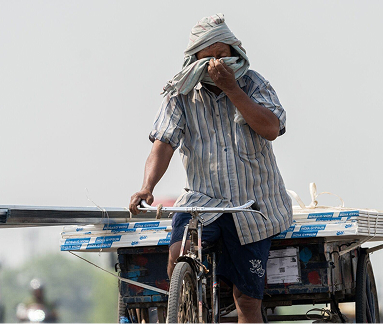
71% of Indians report personally experiencing severe heat waves in the past year; 60% report experiencing increased agricultural pests and disease linked to climate shifts.

Regulatory landscape moving in the right direction

  • RBI's draft climate risk disclosure guidelines and forthcoming climate taxonomy
  • India's forthcoming National Adaptation Plan (NAP)

Stakeholder Ecosystem

Customers

  • MSMEs, FMCG companies
  • Banks, Insurance Companies and other NBFCs
  • Urban local bodies
  • Farmer groups, agri- supply chain players
  • Corporates/Factory owners, Tourism players

Policy Makers & Regulators

  • Ministry of Finance, Ministry of Housing & Urban Affairs
  • Ministry of Environment Forest and Climate Change
  • RBI, SEBI, NABARD, SIDBI, SEBI, NDMA, MDBs and other multilateral climate funds

Key Challenges

Private sector investments in resilience is unknown, largely due to lack of standards for reporting and tagging; companies also face several challenges including no direct revenue stream, unquantifiable returns in the conventional sense, lack of benchmark to compare adaptation deals across asset classes, and data gaps.

Path Ahead

  • Regulatory landscape is becoming structural and will drive market demand for adaptation solutions.
  • Locally-led adaptation movement is gaining institutional backing, with MOEFCC initiating consultations
  • Investment case is becoming clear and loud, WRI’s finding that every $1 invested returns $10.50+ through avoided losses, economic gains, and social co-benefits.

Find out opportunities with Adaptation & Resilience sector

Opportunities Arrow Right

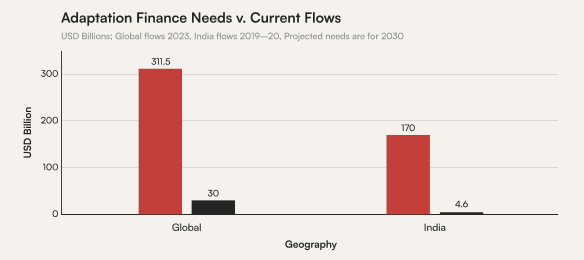
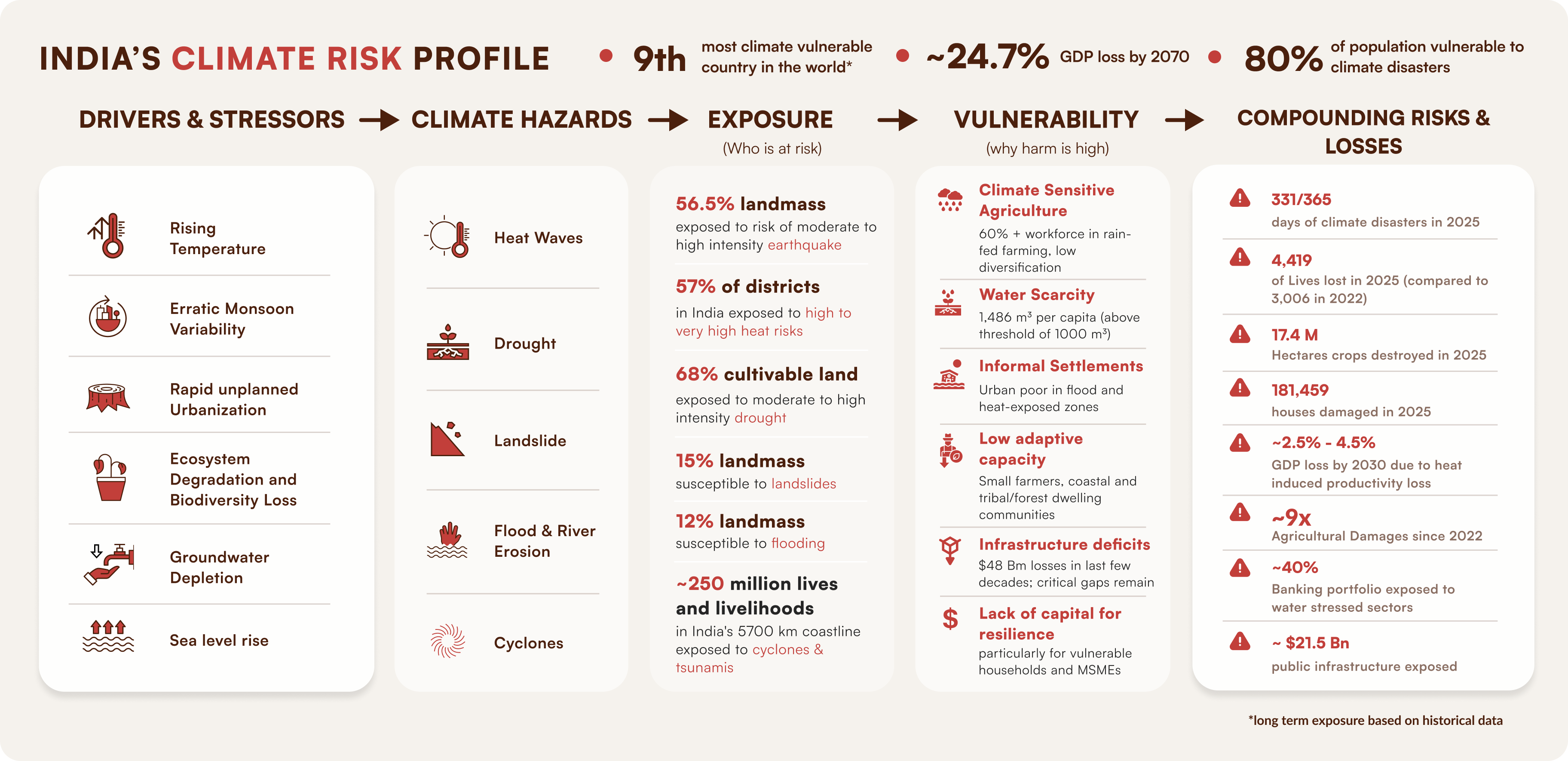
India faces compounding climate risks, yet adaptation is chronically underfunded.

India’s Adaptation Finance Needs

India’s climate finance remains skewed toward solar, wind & efficiency; adaptation, MSME resilience, and urban infrastructure explicitly underfunded.

  • Cumulative investment needed for India to adapt to climate change by the year 2030, is ~ US$ 1 trillion (at 2012 constant price)
  • An estimated investment of 1.67- 1.95% of projected GDP needed to meet urban resilient infrastructure and services by 2050.

Source: Economic Survey of India (2026), CPI India, RBI, MOEFCC, DEA

Cost of Inaction

  • In a BAU pathway, with temperature rise around ~3°C by 2070, India stands to ~US$35 trillion(2021-22 rate).
  • With India projected to spend $4.51 trillion by 2030 on just building new infrastructure, natural hazards pose a risk of losses of up to $1.02 trillion.

Changing the narrative for Private Sector 

  • Growing consensus that adaptation investments are required to address climate change related physical risks, for business continuity. Thus, investments should be counted towards minimizing or managing risk, in addition to generating returns.
  • finance is emerging as a key financing model where government/MDB finance supports initial stages help solution providers to pilot and scale ther operations and private sector financing at a later stage helps them become more commercial.
  • Guarantees, credit enhancement schemes, and project preparation facilities are another set of instruments which can reduce the transaction costs for private investors.

Adaptation & Resilience: Solution Landscape

Commercially Scaling

Opportunities with solutions reaching commercial parity, need capital to scale. 

  • General climate risk analytics dashboards
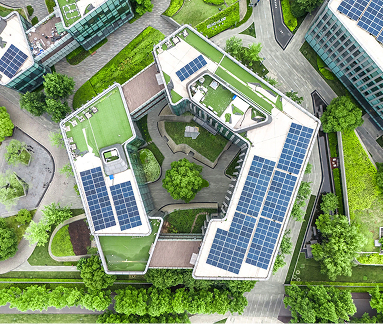
  • Cool roofs, active and passive cooling, and urban heat solutions
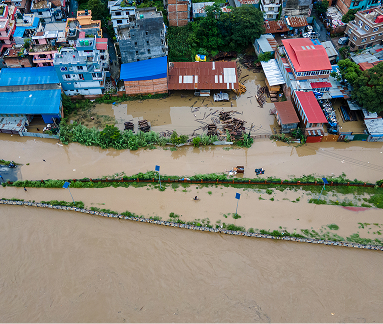
  • Flood and cyclone-resilient affordable housing materials
  • Treated wastewater reuse systems

Applied Innovation

Opportunities with solutions available but need engineering, business model or financial innovation 

  • Parametric insurance for farmers and MSMEs
  • Hyperlocal EWS for last-mile delivery.
  • Climate risk analytics platforms catered to insurers and lenders
  • MSME climate resilience finance products

Fundamental R&D

Opportunities where solutions only exist in labs/pilots, or are yet to be invented

  • India-specific climate forecasting models built using AI/ML to suit context-related geographic and atmospheric conditions.
  • Heat resistant crop varieties
  • Heat resistant electronics, hardware and machinery

Innovation Spotlight 

Startup: Resilience 360
Stage: Seed
Funding Raised: $ 1 Mn
Status: Revenue Generating + Scaling
Innovation: Climate Risk Assessment & AI Digital Tool for Continued risk monitoring.

Startup: OctoLife
Stage: Series A
Funding Raised: $11.9 Mn
Status: Commercial + scaling
Innovation: Provides energy efficient, cost effective cooling solutions

Research Lab:
Wadia Institute of Himalayan Ecology: Ongoing research on tracking and prediction models for glacial melts
IIT Madras: Developing suitable climate change adaptation measures for coastal infrastructure, utilization of water

Opportunities under Adaptation & Resilience Sector

Energy Efficient Active Cooling
Adaptation & Resilience

Energy Efficient Active Cooling

Building energy-efficient active cooling systems to combat heat stress in urban and rural India

Economic Potential, India 2030 3950 Mn USD
Mitigation Impact, India 2030 33 Mn Mt CO2e
Adaptation Risk Index, India 2030 12.5/27
Heat Intelligence to Build Resiliency
Adaptation & Resilience

Heat Intelligence to Build Resiliency

Lack of Heat Intelligence in High Risk Business Operations & Supply Chains

Economic Potential, India 2030 114 Mn USD
Adaptation Risk Index, India 2030 12/27
Banks Need Climate Risk Tagging
Adaptation & Resilience

Banks Need Climate Risk Tagging

Undocumented NPAs with Indian Bank Assets Remaining Unmapped to Climate Hazards

Economic Potential, India 2030 ~620 Mn USD
Adaptation Risk Index, India 2030 12/27
Resilience upgrades invisible to insurers and lenders
Adaptation & Resilience

Resilience upgrades invisible to insurers and lenders

Insurers and lenders lack standardized tools to verify resilience upgrades undertaken by MSMEs and price the resulting risk reduction

Economic Potential, India 2030 ~221 Mn USD
Adaptation Risk Index, India 2030 13.5/27
Building a climate resilient tourism sector
Adaptation & Resilience

Building a climate resilient tourism sector

Tourism sector in climate vulnerable States need faster, safer, and climate-resilient building systems

Economic Potential, India 2030 ~1,124 Mn USD
Adaptation Risk Index, India 2030 13.5/27
Need for Indigenous EWS Systems
Adaptation & Resilience

Need for Indigenous EWS Systems

Absence of Indigenous Sensors & Components for Early Warning Systems, designed for Geo-climatic zones of India

Economic Potential, India 2030 63 Mn USD
Adaptation Risk Index, India 2030 18/27
Early warning system (EWS) for disasters in the Himalayan region
Adaptation & Resilience

Early warning system (EWS) for disasters in the Himalayan region

Absence of affordable, accurate, last-mile early warning system (EWS) for disasters in Himalayan region

Economic Potential, India 2030 ~1,276 Mn USD
Adaptation Risk Index, India 2030 18/27