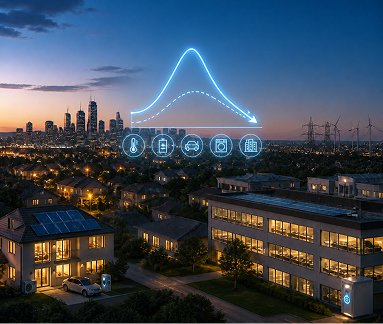
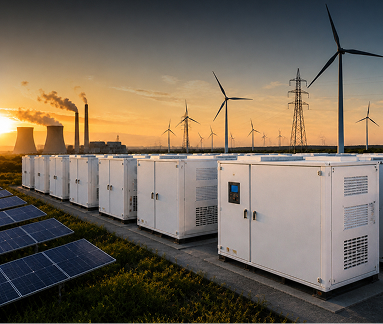
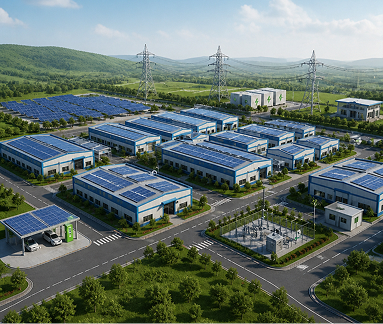
Electricity: The Grid in Transition

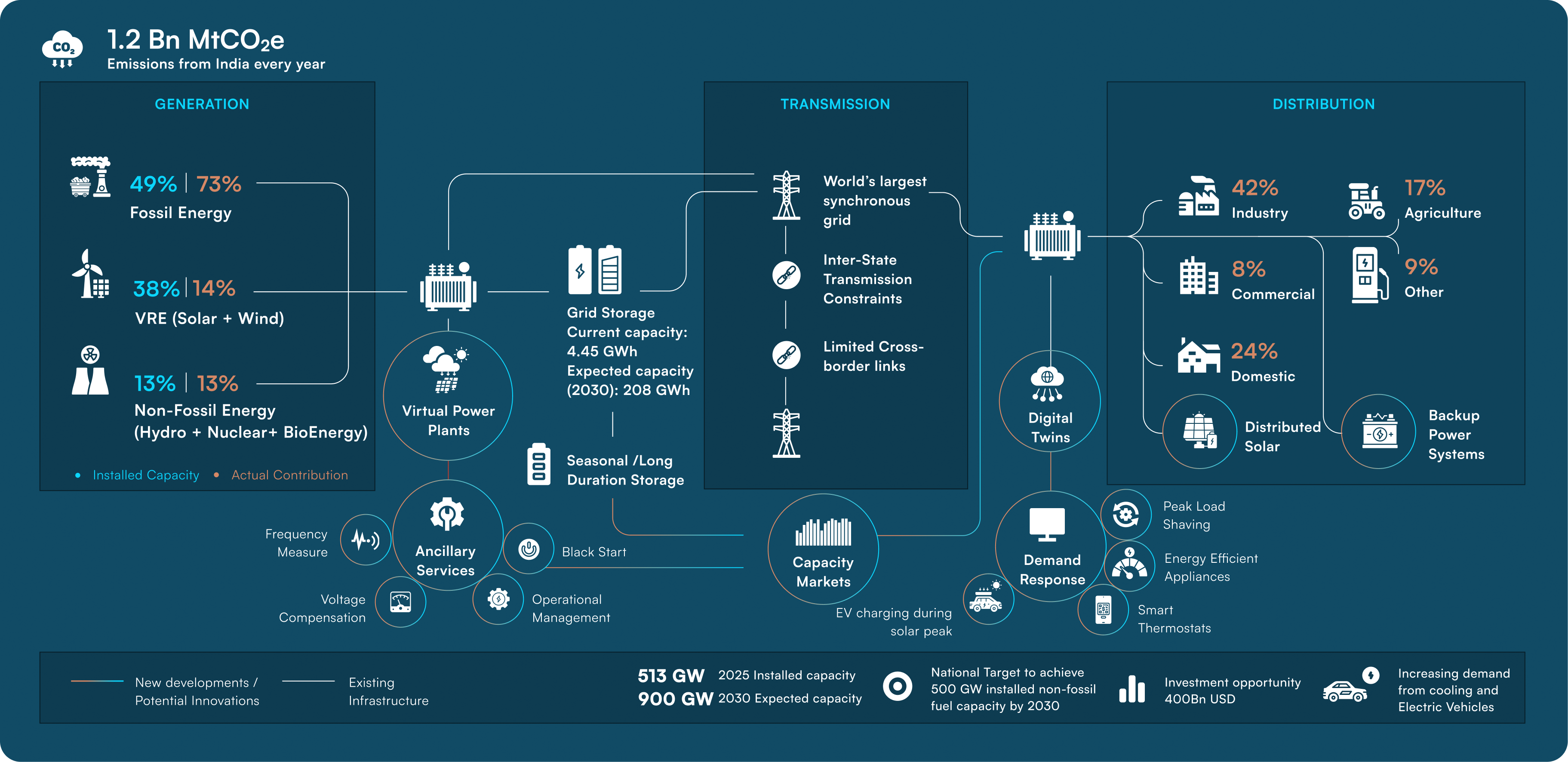
India is the third largest producer and consumer of electricity globally, with an installed capacity approaching 540 GW (April, 2026). More than 50% of its cumulative installed capacity is from non-fossil fuel sources, including hydro. Renewables have accounted for more than 80% of new capacity additions in 2024-2025, with a 2030 target of 500 GW for non-fossil capacity. Yet, VRE currently generates less than 15% of India's total electricity. To increase this contribution, grids, storage and market mechanisms will need to be expanded.
Share of emissions 40%

Why India?

Economic Opportunity

The Indian power sector presents an investment opportunity of more than 400 Bn USD over the next decade on infrastructure upgrades and clean energy transition.

Geopolitical & Climate Risk

Fossil fuels account of more than 70% of electricity generation making the power sector India's largest emissions contributor, and increasing import dependence.

Policy Tailwinds

  • Central level commitment and support through NDC, COP26 pledges, national target.
  • Renewable Purchase Obligation, BESS Viability Gap Funding, PLI for domestic mfg

Stakeholder Ecosystem

Customers

  • Distribution Companies (DISCOMs) - Private & Public
  • Power Generators (Public - NTPC, Private - Tata, Adani)
  • Renewable Energy Companies
  • C&I, MSMEs, Residential Consumers

Policy Makers & Regulators

  • Ministry of Power, Ministry of New & Renewable Energy
  • Central Electricity Regulatory Commission (CERC)
  • Bureau of Energy Efficiency (BEE) State Governments, State Electricity
  • Regulatory Commission
  • Renewable Purchase Obligation, BESS Viability Gap Funding, PLI for domestic mfg

Key Challenges

Weak grid

Persistent structural weakness of the distribution grid, and congestions in transmission network. Weak financial viability of DISCOMs becomes a barrier for any reform.

Surging demand

Growing industrialization and cooling loads in the next 3-5 years will shape the immediate supply-demand pathways, legacy grid expansion models alone will not be sufficient.

Path Ahead

Scaling Renewable Energy & Storage

  • Rapid non-fossil scale up: 2030 Target of 500 GW
  • Two orders of magnitude increase in storage capacity need (400 GWh in 2030 v/s 5 GWh in 2025).

Digital & AI Revolution

Grid flexibility and balancing will be next frontier for transformation due to rapid increase in RE. Emergence of a digital grid, with smart meters, AI-driven grid monitoring & forecasting, and energy & resource management systems will be central to India's future power system.

Find out opportunities with Electricity sector

Opportunities Arrow Right

Electricity: Solution Landscape

Commercially Scaling

Opportunities with solutions reaching commercial parity, need capital to scale.

  • Utility-scale solar/wind development
  • Distributed Solar (C&I, Residential)
  • Demand response aggregation for C&I
  • BESS co-located with Renewables

Applied Innovation

Opportunities with solutions reaching commercial parity, need capital to scale.

  • Grid forecasting, RE Variability management
  • Digital twin models
  • Virtual Power Plants (VPPs)
  • Long-duration storage beyond Li-ion
  • AI-driven energy management systems
  • Higher efficiency RE for land scarcity

Fundamental R&D

Opportunities where solutions only exist in labs/pilots, or are yet to be invented

  • Next-generation storage (thermal/ electrochemical)
  • Advanced renewables (geothermal, marine energy, efficient solar cells)
  • Nuclear Fusion
  • Recycling and second life technologies for solar panels and batteries

Innovation Spotlight

Startup: EdgeGrid
Stage: Seed
Funding Raised: 6Mn USD
Status: Pilot deployment, customer validation
Innovation: B2B platform using IoT and AI to manage energy delivery to households, small businesses, and EV charging stations

Startup: TekUncorked
Stage: Seed
Funding Raised: <1Mn USD
Status: Commercial Pilots, early revenue
Innovation: Smart IoT devices for last-mile power distribution network for outage management, capacity planning, monitoring, etc

Research Lab: IIT Bombay
Grid Integration Lab: Prof. Z. H. Rather - RE
NCPRE: Prof. P. R. Nair - next generation photovoltaic device physics

Opportunities under Electricity Sector

Demand flexibility and demand management
Electricity

Demand flexibility and demand management

Aiding peak-load management by tapping into demand flexibility and demand-side management targeted at domestic and commercial customers

Economic Potential, India 2030 ~530 Mn USD
Mitigation Impact, India 2030 30 Mn Mt CO2e
Scaling cost-effective grid-forming inverters
Electricity

Scaling cost-effective grid-forming inverters

Reducing India’s dependence on coal-based grid stability and enabling high Variable Renewable Energy (VRE) integration through cost-effective grid-forming inverter

Economic Potential, India 2030 ~1300 Mn USD
Mitigation Impact, India 2030 32 Mn Mt CO2e
Demand aggregation for low operating range
Electricity

Demand aggregation for low operating range

Enabling Micro Small & Medium Enterprises (MSME)’s access to demand aggregation solutions and cost-effective electric systems designed for low operating range

Economic Potential, India 2030 590 Mn USD
Mitigation Impact, India 2030 19 Mn Mt CO2e