Built Environment: Growing infra with heat stress

As India undergoes rapid urbanisation and growth in the next 50 years, building housing and commercial units becomes imperative. The building sector today contributes to 33% of total GHG emissions, mainly due to cement manufacturing (embodied emissions) and energy usage (operational emissions). Sustainable buildings present the opportunity to conserve energy and resources and most critically, massively cut down emissions and pollution.
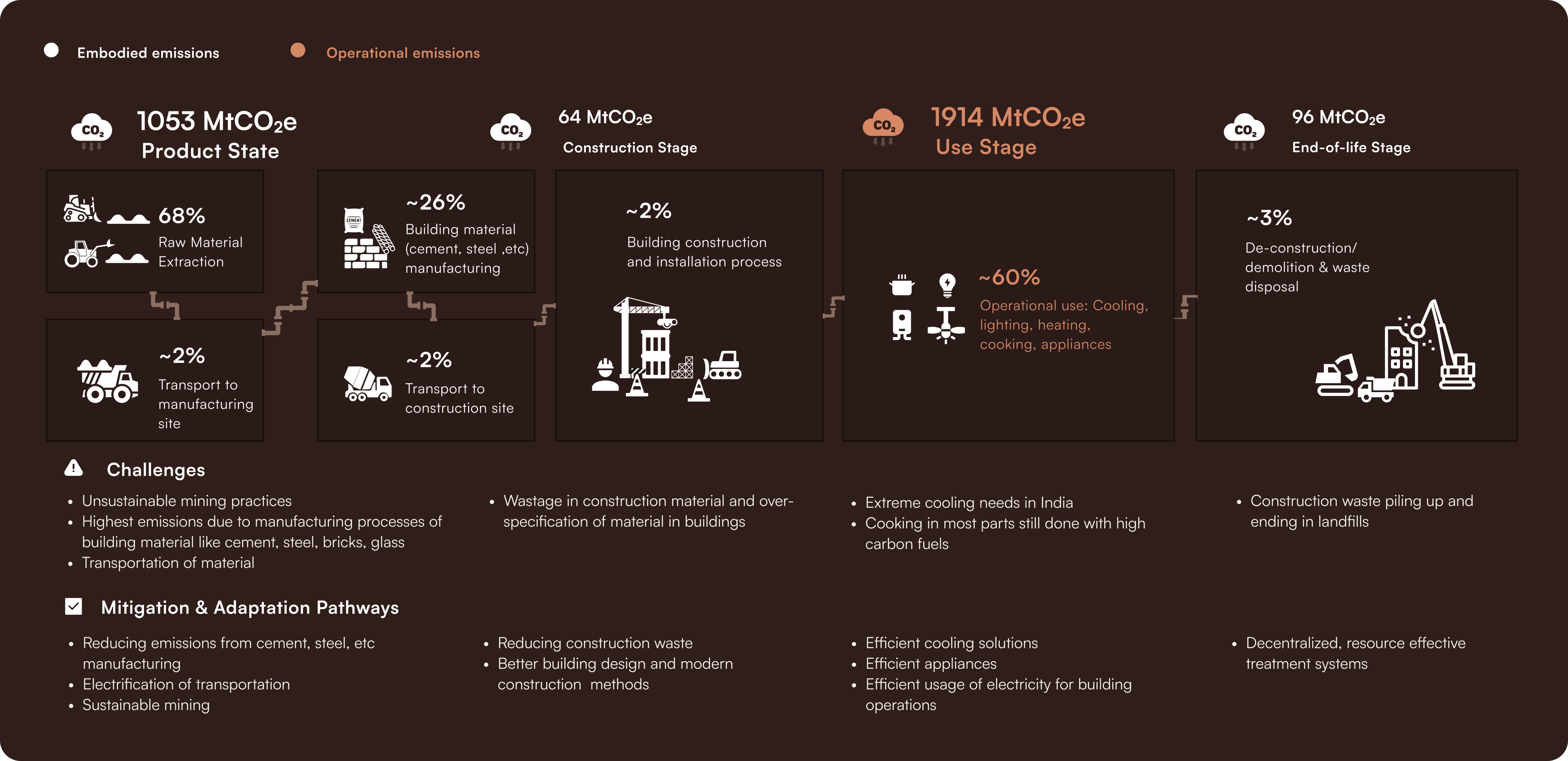
Share of emissions 33%(overlap between energy, industry and transport emission)

Why India?

Economic Opportunity

50% of urban infrastructure till 2050 yet to be built, with ~USD 800 Bn expected to be spent by 2037. India is the 2nd largest cement producer (8% of global capacity)

Growth drivers

Energy conservation and large cooling need

  • Energy efficient buildings could cut energy needs by upto ~20%, lowering load on India’s grid
  • 1Bn+ people in India could face extreme heat stress, signifying high cooling demand

Policy Tailwinds

  • ECBC guiding energy efficiency, sustainability and RE integration in buildings
  • Indigenous rating frameworks like GRIHA and IGBC as technical benchmarks for buildings

Stakeholder Ecosystem

Customers

  • Real Estate Developers, Architects and Structural engineers
  • Cement manufacturers, RMC players
  • Buildings Managers & Users (IT Sector, Hotels, Hospitals, RWAs)
  • Industrial: Data centres,
  • Urban Local Bodies (ULBs)

Policy Makers & Regulators

  • Ministry of Housing & Urban Affairs
  • Ministry of Power (Bureau of Energy Efficiency)
  • Bureau of Indian Standards (BIS) sets National Building Code
  • Central Pollution Control Board
  • Green Building Councils (GRIHA, IGBC)

Key Challenges

Embodied emissions overlooked

ECBC codes as well as GRIHA and LEED have mainly focused on operational emissions, giving low importance to embodied emissions

Low carbon material usage and material waste

Traditionally low carbon cement is preferred due to reliability and strength; frequent overspecification of material leads to redundancy

Path Ahead

Demand

  • Developers moving towards internal sustainability mandates due to higher rental rates and investor interest for green properties
  • Energy security for India means less consumption of energy through building management systems and efficient appliances

Regulations

ECBC will soon upgrade to ECSBC which will bring embodied carbon into focus as well

Find out opportunities with Built Environment sector

Opportunities Arrow Right

Built Environment: Solution Landscape

Commercially Scaling

Opportunities with solutions reaching commercial parity, need capital to scale.

  • Existing blended cements (PPC, PSC)
  • Building management systems
  • Energy-efficient cooling solutions
  • Other efficient appliances
  • Sustainable building design technologies

Applied Innovation

Opportunities with solutions available but need engineering, business model or financial innovation

  • LC3 cement
  • Silicate-based cements
  • CO2 curing of cement
  • Low carbon fuels for cooking
  • Carbon capture, utilisation and storage from klin

Fundamental R&D

Opportunities where solutions only exist in labs/pilots, or are yet to be invented

  • Advanced SCMs, binders, admixtures, and geopolymers
  • Kiln electrification / alternate fuels
  • Reuse, recycling of construction waste
  • Electrochemical pathway replacing kilns

Innovation Spotlight 

Startup: Atomberg Technologies
Stage: Series C
Funding Raised: 119Mn USD
Status: Scaling Revenue
Innovation: Energy efficient ceiling fans kitchen appliances.

Startup: Smart Joules
Stage: Series B
Funding Raised: 21Mn USD
Status: Scaling Revenue
Innovation: Building management systems to deliver energy efficiency for residential and commercial spaces

Research Lab: IIT-M, TLC2 Lab
Professor: Dr. Manu Santhanam
Innovation: Focusing on sustainable cement chemistry (such as LC3), recycling construction and demolition (C&D) waste, and advanced 3D concrete printing.

Opportunities under Built Environment Sector

New construction methods to reduce waste and time
Built Environment

New construction methods to reduce waste and time

Optimising material usage with better construction methods to reduce waste and maximise construction speed in India

Economic Potential, India 2030 14,250 Mn USD
Mitigation Impact, India 2030 53 Mn Mt CO2e
Recycling and reuse of C&D waste
Built Environment

Recycling and reuse of C&D waste

Enabling recycling and reuse infrastructure for the large amount of C&D waste generated in India

Economic Potential, India 2030 16,700 Mn USD
Mitigation Impact, India 2030 64 Mn Mt CO2e
Low-carbon cement production
Built Environment

Low-carbon cement production

Reducing India’s clinker factor by creating a high performance and cost-effective alternative for clinker replacement for housing and other infrastructure

Economic Potential, India 2030 11,750 Mn USD
Mitigation Impact, India 2030 163 Mn Mt CO2e