Transport: Driving electrification & biofuels

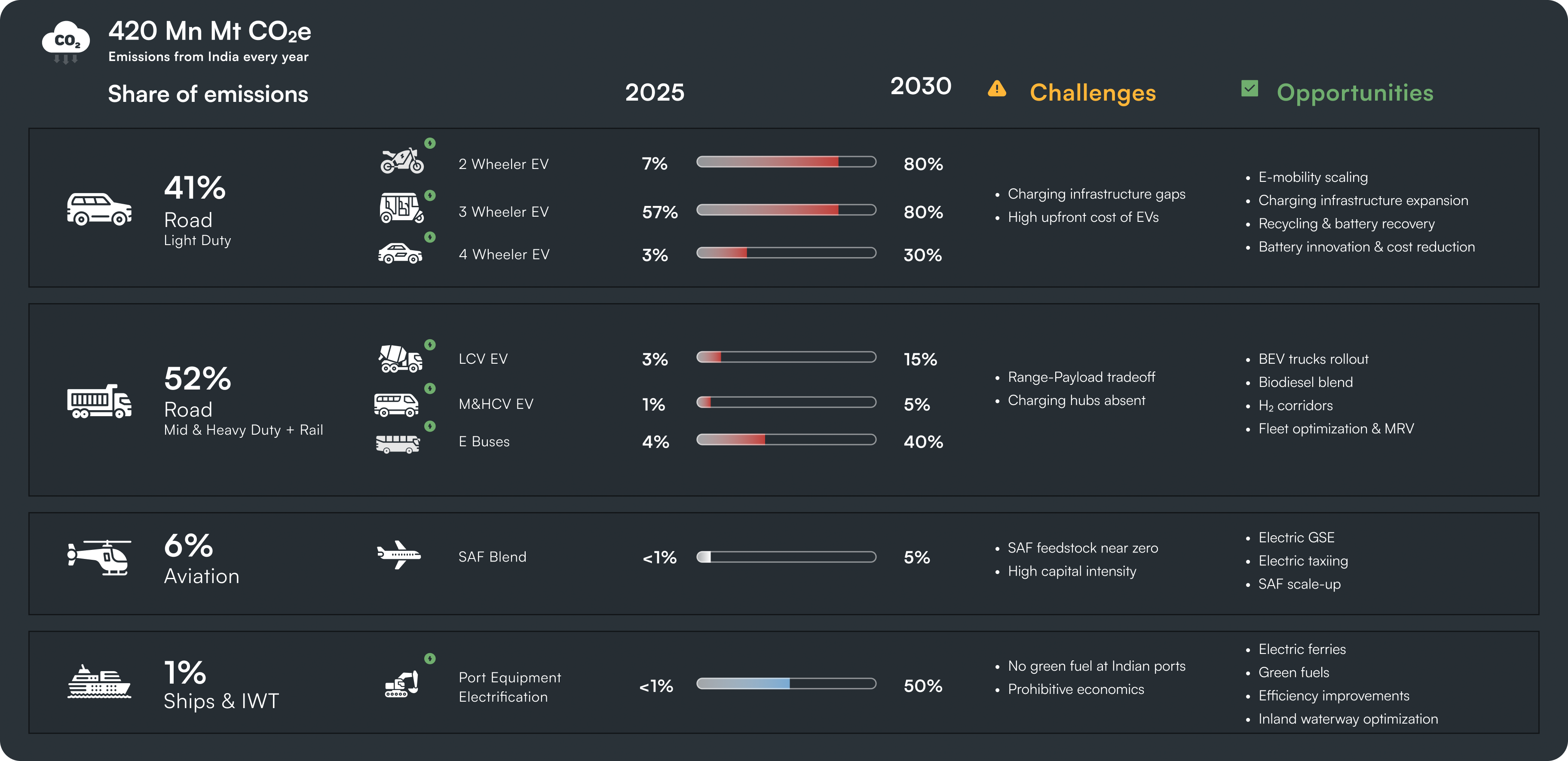
India is the third-largest automotive producer globally with 240 Bn USD in industry turnover and 30 million jobs. Passenger travel is projected to triple and freight demand to grow five-fold between 2020 and 2050. Meeting this demand relies heavily on imported fossil fuels, exposing India to severe economic vulnerabilities. While the light commercial vehicles (2W + 3W) are rapidly electrifying due to favorable TCO, the hard-to-abate MHDT segment remains diesel-dependent due to operational friction and a lack of high-capacity corridor charging.
Why India?

Economic Opportunity

Automotive sector contributes 7% of GDP and 49% of manufacturing GDP; Indian EV market is poised to create a $100+ billion opportunity by 2030

Geopolitical & Climate Risk

Indian transport depends heavily on imported fuels (~80%). Country's fastest-growing emissions sector - could reach 650 Mt by 2050 under current policies

Policy Tailwinds

  • Electrification Push: PM E-DRIVE, PM-eBus Sewa, PLI-Auto + PLI-ACC
  • Biofuels Push: Ethanol, SAF blending mandates, CCTS methodology under development

Stakeholder Ecosystem

Customers

  • Fleet operators and third party logistics
  • State Transport Undertakings
  • Individual 2W and 3W owners
  • Battery manufacturers and recyclers
  • Airlines and Shipping companies

Policy Makers & Regulators

  • Ministry of Heavy Industries
  • Ministry of Road Transport and Highways
  • Ministry of Civil Aviation
  • Bureau of Energy Efficiency (BEE)
  • Central Pollution Control Board

Key Challenges

Charging Infrastructure gap

India has 1 public charging station for every 235 EVs - far above global norms; MHDT-grade corridor charging commercially non-existent along freight routes

Financing gap

Commercial EV adoption is constrained by lenders pricing in worst-case battery degradation in the absence of residual value underwriting standards

Path Ahead

Mobility will grow exponentially

Car ownership will triple (3X) & air travel will double (2X) by 2050.

  • W and 3W electrification is commercially self-sustaining
  • Remaining gaps in 4W EV financing, corridor charging infrastructure, alternative fuels for aviation & long-haul freight, and the battery supply chain are solvable with innovation, targeted capital and policy.
  • Electrification, fuel efficiency, and modal shift combined can cut transport emission by 71% by 2050

Find out opportunities with Transport sector

Opportunities Arrow Right

Transport: Solution Landscape

Commercially Scaling

Opportunities with solutions reaching commercial parity, need capital to scale.

  • Electric 2W and 3W fleet deployment
  • Public EV charging infra (urban)
  • Battery swapping networks for 2W/3W
  • Electric buses (OpEx Model)
  • Digital freight platforms

Applied Innovation

Opportunities with solutions available but need engineering, business model or financial innovation

  • OEM-independent battery SoH certi.
  • Highway corridor charging for HD trucks
  • ZET-specific NBFC
  • SAF via alcohol-to-jet from agri-residues
  • Last-mile cold-chain EV reefer vehicles
  • LFP battery recycling economics
  • REE-free traction motors

Fundamental R&D

Opportunities where solutions only exist in labs/pilots, or are yet to be invented

  • Hydrogen fuel cells for long-haul freight
  • Low-GWP transport refrigeration systems for electric cold-chain vehicles
  • AEM electrolyzer stacks for low-cost green hydrogen (without iridium)
  • Direct LFP cathode regeneration

Innovation Spotlight 

Startup: Ather Energy
Stage: Listed (IPO May 2025)
Funding Raised: ~$450Mn pre-IPO
Status: Revenue generating, scaling
Innovation: Vertically integrated electric scooters with proprietary charging network; Hardware & software stack

Startup: Chara Technologies
Stage: Series A
Funding Raised: 6.2Mn USD
Status: Revenue generating
Innovation: Rare-earth-free synchronous reluctance motors for EVs

Research Lab: IIT Bombay
EV Powertrain Lab (Prof. Sandeep Anand) GaN motor controllers, rare-earth-free SRM/SynRM motors, BMS design
Electrochemical Energy Lab (Prof. Sagar Mitra) Li-ion and solid-state battery prototyping, advanced electrode materials

Opportunities under Transport Sector

Agri-residue feedstock supply chain
Transport

Agri-residue feedstock supply chain

Building India's agri-residue feedstock supply chain to make CBG blending and SAF mandates commercially deliverable

Economic Potential, India 2030 180 Mn USD
Mitigation Impact, India 2030 15 Mn Mt CO2e
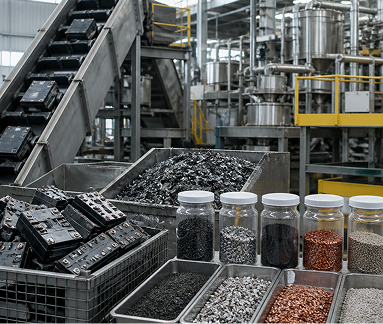
LFP battery recycling economics
Transport

LFP battery recycling economics

Enabling profitable LFP battery recycling by integrating novel sorting and recycling pathways into a viable business model

Economic Potential, India 2030 136 Mn USD
Mitigation Impact, India 2030 4 Mn Mt CO2e